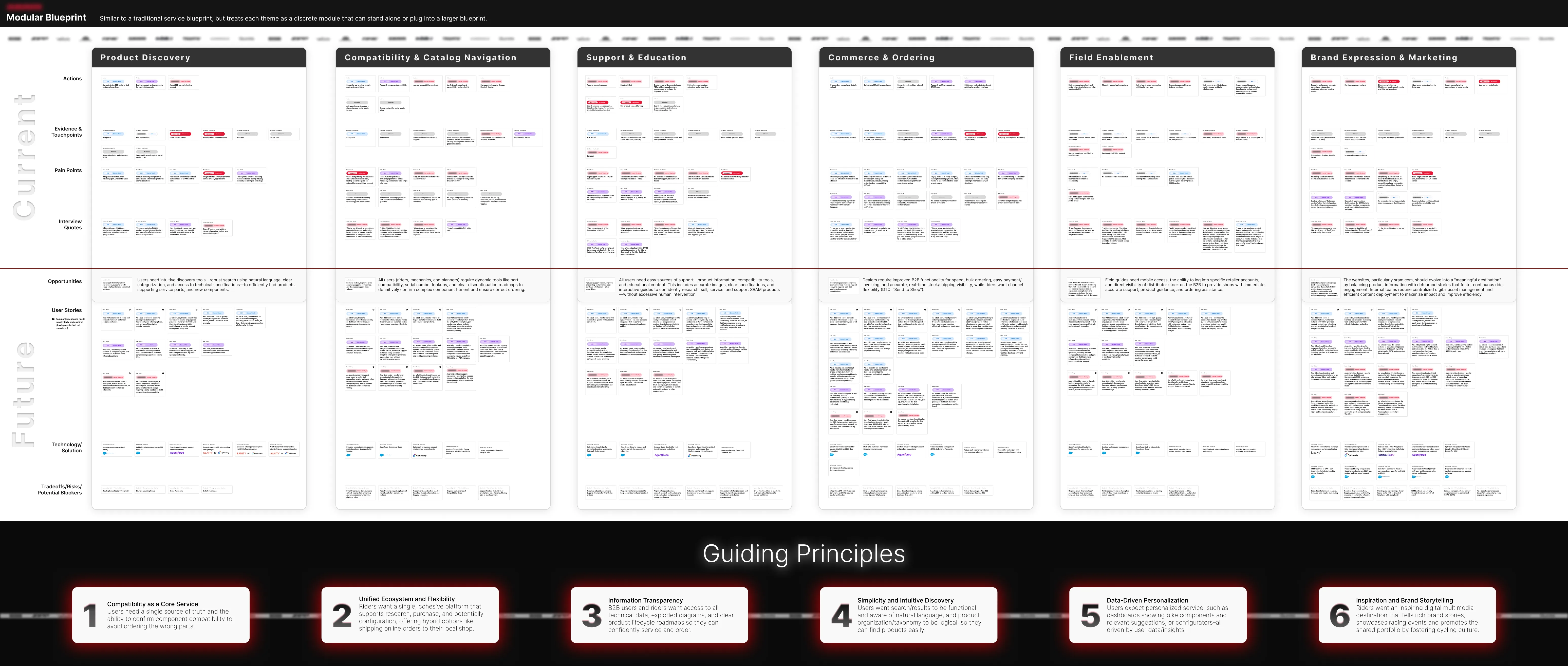

Modular Blueprint strategic artifact for a global bicycle OEM digital experience — a large-format grid mapping six capability areas (Product Discovery, Compatibility & Catalog Navigation, Support & Education, Commerce & Ordering, Field Enablement, Brand Expression & Marketing) across current and future state rows, with six guiding principles including Compatibility as a Core Service, Unified Ecosystem and Flexibility, and Data-Driven Personalization
All Case Studies
Service DesignDigital StrategyUX ResearchB2B PortalEnterprise Experience Design

Experience Strategy and B2B Portal Modernization for a Global Bicycle OEM

10 weeks
Internal teams, 2,500+ dealers, global rider base
Consumer hardware / global bicycle components manufacturing
Representative Output

Service blueprint mapping the full digital ecosystem across three stakeholder groups (internal, B2B dealers, end riders), paired with a future-state strategic opportunity map organized around six design principles.

Modular Blueprint strategic artifact for a global bicycle OEM digital experience — a large-format grid mapping six capability areas (Product Discovery, Compatibility & Catalog Navigation, Support & Education, Commerce & Ordering, Field Enablement, Brand Expression & Marketing) across current and future state rows, with six guiding principles including Compatibility as a Core Service, Unified Ecosystem and Flexibility, and Data-Driven Personalization
Impact

31% projected reduction in support volume through improved self-service design

Research synthesized across 26 stakeholder and customer interviews into a single strategic artifact the organization could act on

"We now have a clear blueprint to align multiple product and digital teams around a single roadmap." — Client Strategy Lead

Problem

A bicycle component manufacturer had grown its digital presence organically across B2B, direct-to-consumer, and service channels — resulting in a fragmented ecosystem of disconnected platforms that no single team fully owned or understood. Product discovery required insider knowledge. Compatibility information lived nowhere centralized. Inventory data was unreliable at the dealer level. And the brand's digital storytelling was scattered across systems that didn't talk to each other. Despite a strong product portfolio, the digital experience was eroding trust with dealers and failing to convert rider engagement into loyalty.

Approach
1

Conducted 26 interviews across three stakeholder persona groups: internal teams, B2B retailers and dealers, and end riders

2

Synthesized interview transcripts into modular themes and user stories

3

Mapped the current-state experience, pain points, and technology limitations across all three groups

4

Developed a future-state service blueprint grounded in six strategic design principles

5

Produced a strategic opportunity map to guide prioritization across product, digital, and service teams

Solution

A comprehensive service blueprint, journey maps, pain point synthesis, and strategic opportunity map — that gave the organization a unified picture of its digital ecosystem for the first time. The future-state vision was built around six principles: Compatibility as a Service, Simplicity in Discovery, Unified Architecture, Information Transparency, Lifestyle-Driven Brand Expression, and Personalized Dashboards for Riders and Shops. The output aligned multiple internal product and digital teams around a single shared roadmap for the next phase of platform investment.